


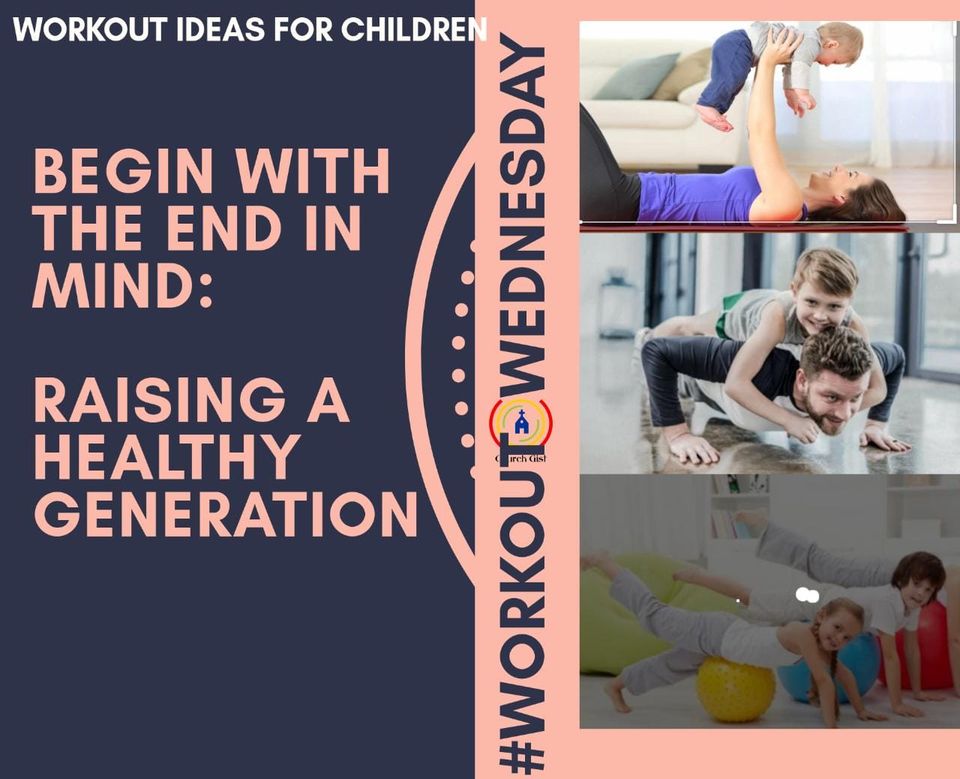
According to the popular cliché: a family that prays together, stays together; also, a family that works out today, will grow healthy together.
Scientific evidence shows that physical activity is positively related to cardiorespiratory and metabolic health in children and youth. Research has also proven that maintaining high amounts and intensities of physical activity starting in childhood and continuing into adult years will enable people to maintain a favourable risk profile and lower rates of morbidity and mortality from cardiovascular disease and diabetes later in life. This finding correlates perfectly with what is written, “Train up a child in the way he should go: and when he is old, he will not depart from it” (Proverbs 22:6).
Due to the paradigm shift especially in urban areas, children and youth are gradually becoming less physically active as part of play, games, sports, transportation, recreation, physical education, or planned exercise, in the context of family, school and community activities; hence there is a need to consciously include them in physical exercises in order to ensure a healthy generation of adults.
For children age 5 years and above, it is recommended that most of their daily physical activity should be aerobic. Aerobic relates to involving, or requiring free oxygen, therefore aerobic exercise which is also known as cardiovascular exercise, depends mainly on the aerobic energy generating process of turning carbohydrates into energy. Examples of aerobic activity include: brisk walking, running, bicycling, jumping rope and swimming.
You can get your children interested in exercises by trying out some of these ideas at home:
1. Mountain Climbers: Get into a push-up position and then alternate bringing your knee to your elbow. You can do same side connections or crisscross. The idea is to move fast and work up a sweat!
2. Squats: Children are able to do the squats easily. See who can get the deepest squat or the most squats in 60 seconds. Stand with your feet shoulder’s width apart and do deep knee bends. Make sure you keep your knees behind your toes and your arms straight.
3. Leg Raises: Lay on your side or on your back and lift your legs without bending at the knee. Try to hold at the top. This works your lower abdominals but be careful not to let your lower back arch.
4. Lunges: Step forward and bend your front knee to a 90-degree angle. The goal is to have your back knee touch the ground without letting your front knee extend past your toes. To make it harder, carry (small) children in each arm and lunge as you walk across the room.
5. Butterfly Kicks: Lay flat on your back and extend your legs straight out. Imagine you are swimming and begin to flutter kick your legs without bending at the knee. Start with your feet high off the floor, as the move gets more difficult the closer the action is to the floor.
You can also incorporate vigorous-intensity activities that strengthen the muscle and bone, at least 3 times per week.
Join any of our Telegram Channels.
t.me/ChurchGist
t.me/CGWitness
Leave a comment Here OR any of these platforms:
Instagram
https://www.instagram.com/therealchurchgist/
Twitter
https://twitter.com/therealchurchg1
YouTube
https://www.youtube.com/channel/UCEcolEnQjmehziQQPOcHSeA/
YouTube Channel
https://www.youtube.com/channel/UCD_X0B5RIRkgN5m05DS-8eg/
