


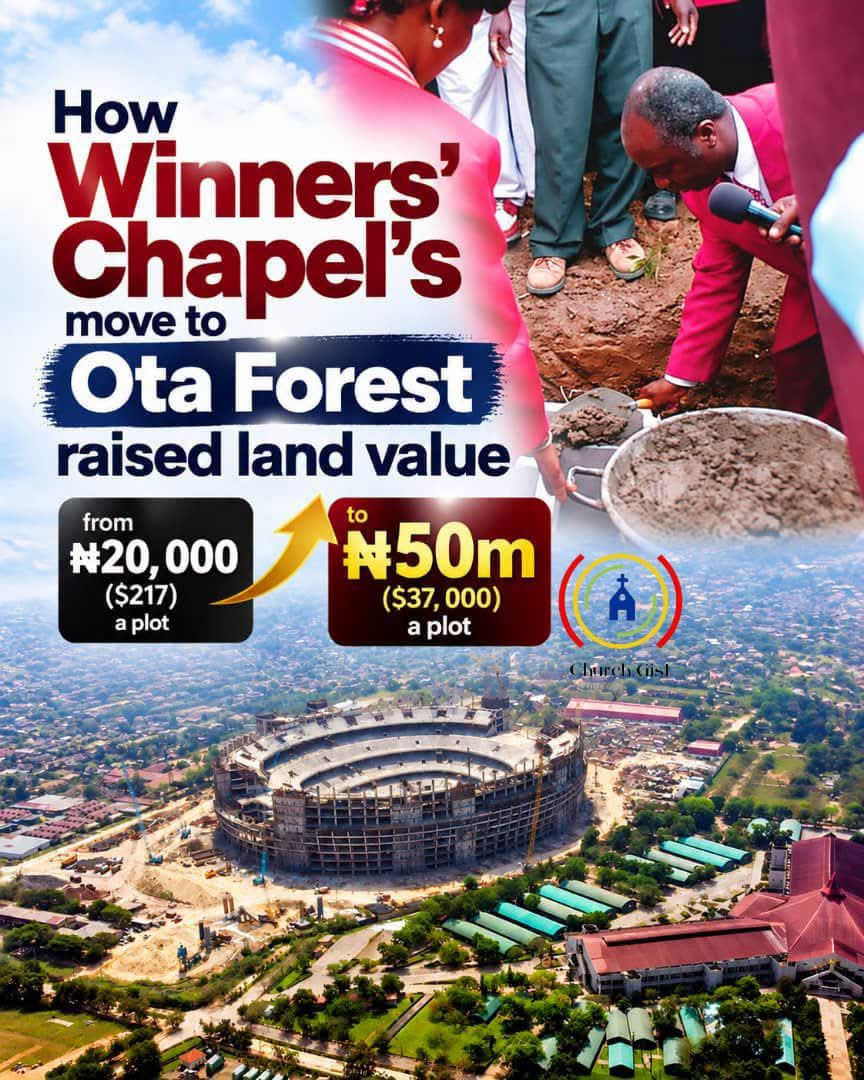
How Winners’ Chapel’s move to Ota Forest raised land value from ₦20, 000 (£217) to ₦50m (£37, 000) per plot
A, look at the benefits of the Church to the Economy in terms of land appreciation: Canaanland in perspective
Emmanuel had just retired from the Nigerian Railway Corporation. It was shortly after Independence in 1960 and as one of the pioneer staff, he was given a gratuity that was intended to help him purchase and build a retirement home. This was more urgent because he had to vacate the official accommodation of the NRC at Oyingbo in Lagos. However there was a burning question. Mushin Olorunsogo’s landed property which was his desire was expensive but beautiful while Surulere area was essentially a forest. He had to choose wisely. The cost of a plot in Mushin would easily get him 2 acres in the bushy Surulere. As the name implied, Surulere demanded patient development. Pa Emmanuel decided he was in his old age and Mushin was more desirable. He chose a plot in Mushin.
A few years down the line, the Head of state, General Gowon ordered the building of the National Stadium in Surulere. Afterwards, the National Theatre, Iganmu was also built close by. Surulere had suddenly transformed from bush to prime property and under Pa Emmanuel’s nose, Mushin gradually became a slum. Papa died in 1979. The message was not lost on his last born son. In 1998, his son who happened to join Winners’ Chapel same 1998, came to the Winner’s Camp (which soon became known as Canaanland) for the ground breaking of Faith Tabernacle.
As a result of his childhood experience Mr Emmanuel’s son, Ade decided not to lose the opportunity presented to him like his father some decades back. Just outside the camp and adjacent to the portion to be used as Faith Academy, Ade purchased several acres over the next 15 years. One, 2, 3 or even 5 plots at a time. After a while, he had spent about ₦13 million cumulatively purchasing several plots. Today, Ade is a billionaire.
The spatial and economic evolution of Ota, Ogun State, stands as one of the most prominent examples of religious tourism and institutional expansion driving real estate hyper-appreciation in Sub-Saharan Africa. The shift from a feared, dense forest known as a den of wicked Ota witches (Aje Ota) to a bustling economic metropolis spans a timeline of 27 years, bounded by the completion of 2 mega-auditoriums: the Faith Tabernacle in 1999 and the impending dedication of The Ark.
Here is a brief history of landed property price appreciation around Canaanland, Ota, from September 1999 to September 2026.
Key Historical Drivers of the Appreciation.
- The 1999 Inception: Transforming the “Wilderness”
When the church acquired its foundational 530 acres for ₦200 million in May 1998, the Idiroko Road axis was largely disconnected from mainstream commercial interests. Following the historic 12-month construction and dedication of the 51,400-seat Faith Tabernacle on 18 September, 1999, the immediate peripheral lands, which initially changed hands for nominal community receipts of ₦10,000 to ₦20,000, instantly experienced a baseline reassessment as a place of global gathering.
- The Anchor Institutional Effect (2002–2010).
The establishment of Covenant University in 2002 transformed Ota from a weekly Sunday service event as well as monthly Saturday Breakthrough Summit coupled with an annual pilgrimage destination (centered around the Shiloh event) into a permanent residential and educational hub. The urgent demand for staff off-campus accommodation initially, eventual construction of staff apartments and standard retail outlets catalyzed a massive wave of private construction in nearby areas like Joju, Iyana-Iyesi and Atan Ota.
Plots that sold for under ₦100,000 before the university opened quickly broke past the half-million Naira threshold.
- Mega-Estate Consolidation (2011–2019).
The church’s acquisition of approximately 8,000 hectares for the massive Canaan City Housing Scheme introduced a gated-community dynamic to the area. Private real estate companies as well as average and high net worth individuals began buying large tracts of land nearby to develop competitive residential estates.
- The 2021- 2026 Speculative Surge: Anticipating “The Ark”
The announcement first in November 2020, the relocation of Faith Academy in January 2021 as well as eventual ground breaking for the Ark in March 2021 stunned Ota. Cost of property around the Ark immediately moved from about ₦5 million to ₦15 million
By September 2026, landed property surrounding Canaanland had shifted entirely into a premium bracket. The primary catalyst for recent appreciation is the impending dedication of The Ark, a 109,345-capacity stadium-sized auditorium intended as the ministry’s new core legacy structure. The landmark event is slated to draw global traffic between September and November 2027.
Currently, investors are engaged in aggressive speculation. Plots directly adjacent to or highly accessible from Canaanland are commanding between ₦6 million and ₦12 million, depending on title authenticity, while lands further down the Atan/Owode axis trade between ₦1.5 million and ₦4 million.
On the other hand, properties facing the Ark directly opposite or shared-boundary adjacent to Canaanland’s new focal point are indeed commanding premium figures up to ₦50 million or more as we approach the late 2026/early 2027 milestone.The extraordinary surge for these specific plots is driven by 3 distinct real estate phenomena:
- Air Rights, Visibility, and Global Corporate Footprints.
The stretch directly opposite the site of The Ark is no longer being valued as mere “residential land.” It is now prime commercial real estate with massive marketing power.High-Volume Foot Traffic: The 109,000-capacity auditorium will attract hundreds of thousands of weekly visitors. Companies want to place banks, international fast-food franchises, standard retail centers and corporate billboards where millions of global eyes will see them.
Severe Supply Constraints:
There is a finite, un-multipliable amount of land directly facing the main gates.Since the church already owns the vast majority of the land mass inside the Canaanland grid, private buyers are competing fiercely for the very few privately owned plots right across the street.
- High-Yield Hospitality Conversion (The “Boutique Hotel” Premium).
During major events like the annual Shiloh gathering, the demand for premium lodging within short walking distance of the auditorium vastly outstrips supply.
Investors buying these ₦50 million plots are not looking to build standard rental apartments. They are building boutique hotels, high-end short-let apartments, and guest suites tailored for international delegates.At these premium locations, rooms can fetch anywhere from ₦50,000 to over ₦150,000 per night during peak events. Investors willingly pay ₦50 million for the land because the projected cash flow allows them to recoup their capital remarkably fast.
- Absolute Security and “Zero-Risk” Infrastructure.
Landed property in Nigeria often carries hidden costs like poor accessibility, lack of grid power or security vulnerabilities. Plots directly adjacent to Canaanland bypass these issues entirely.
:Infrastructural Spillover: Land owners and residents now benefit from the recent attention on the roads which for long had been a mensce to live with save for the Living Faith Church’s constant intervention in terms of maintenance and high-security presence maintained around the church perimeter and bereft of government intervention until 2024.
However that’s not all.
Canaanland’s initial 530 acres cost ₦200 million. However, it has grown over the years to 5000 acres, 10,000 acres, 17,000 acres and now 24,000+ acres which according to some is now more than half of the Redemption City. There was a time Bishop Oyedepo announced a 123km wall around Canaanland. However that has now been partially pulled down to make way for the continuous expansion.
The most open secret in landed property valuation is the rise of Canaanland from obscurity to premium price.
Based on current real estate market data, the 24,711 acres of Canaanland is estimated to be worth between ₦1.24 trillion and ₦1.98 trillion in Nigerian Naira, which translates to approximately $930 million to $1.49 billion in US Dollars.This valuation accounts for the land’s transition from agricultural outskirts in 1997 into a premium, infrastructure-heavy institutional mega-hub.
Below is the mathematical breakdown of how inflation, currency shifts and hyper-appreciation drive this valuation.
- Current Market Value Breakdown (2026).
Land prices in the Sango-Ota/Agbara industrial corridor have expanded drastically. A standard residential or mixed-use plot in nearby estates sell for ₦5 million to ₦8 million. Since an acre comprises roughly 6 standard plots, raw acreage in the area commands ₦30 million to ₦48 million per acre at the least.However, due to Canaanland’s specialized infrastructure—including independent power plants, premium road networks and major landmarks like Covenant University, Faith Tabernacle and The Ark—the land values command a steep commercial premium.
Historical Comparison: 1997 vs. Today
To understand the velocity of this growth, understand the initial baseline provided
:1997 Benchmark: 530 acres cost ₦200 million. This breaks down to roughly ₦377,358 per acre.
The Exchange Shift: In 1997, the dollar-to-naira rate hovered around ₦82/$1. That initial ₦200 million investment was worth roughly $2.44 million USD ($4,600 per acre).
Appreciation Rate: Moving from ₦377,358 to ₦50,000,000 per acre represents an absolute appreciation factor of roughly 132.5x in local currency.
While cumulative inflation in Nigeria over the last 3 decades has eroded the purchasing power of the naira by over 99 per cent, real estate in active corridors has outpaced inflation.
This indeed shows the ripple effect the Church has on empowering citizens of the society. The same applies for many other church properties in Nigeria from Redemption City to Prayer City to Deeper Life International Conference Centre to Gospel Faith Mission International Camp and Foursquare Camp, Ajebo among many others.
Essentialy, Churches in Nigeria have been a major catalyst for real estate appreciation in peri-urban areas and suburbs, effectively turning remote, undeveloped regions into high-value urban hubs. These Megachurches and ministries have pioneered real estate development by acting as anchor institutions that attract infrastructure, population and commerce.
To God be the Glory.
#ChurchGist
